Friday, March 6

Unit Transfer Method Versus Model Drawing

The question is the excerpt from the UTM publication, Chapter 1.1.
The following question is used to illustrate the Model Approach and Unit Transfer Method.

You will realise that the fundamental concept between UTM and MD is the same. While MD uses bar diagram and visual spatialisation, UTM uses tabulation and logical reasoning.

Question

5/6 of the buses were owned by Company C and the rest by Company S. Company S bought another 900 buses and now owns 2/3 of all the buses. How many buses does Company S have now?

Answer:


Try to solve the following using UTM:

Tom had a box of red beads and yellow beads. When he added in 30 red beads, 20% of the beads were yellow beads. He added another 100 yellow beads; as a result, 60% of the beads in the box were yellow. How many red beads were there in the box at first?

Monday, March 2

IMMEDIATE PRESS RELEASE

Mastering Heuristics Series
Mathematical Strategies Made Simple

At last, a guidebook that delivers!

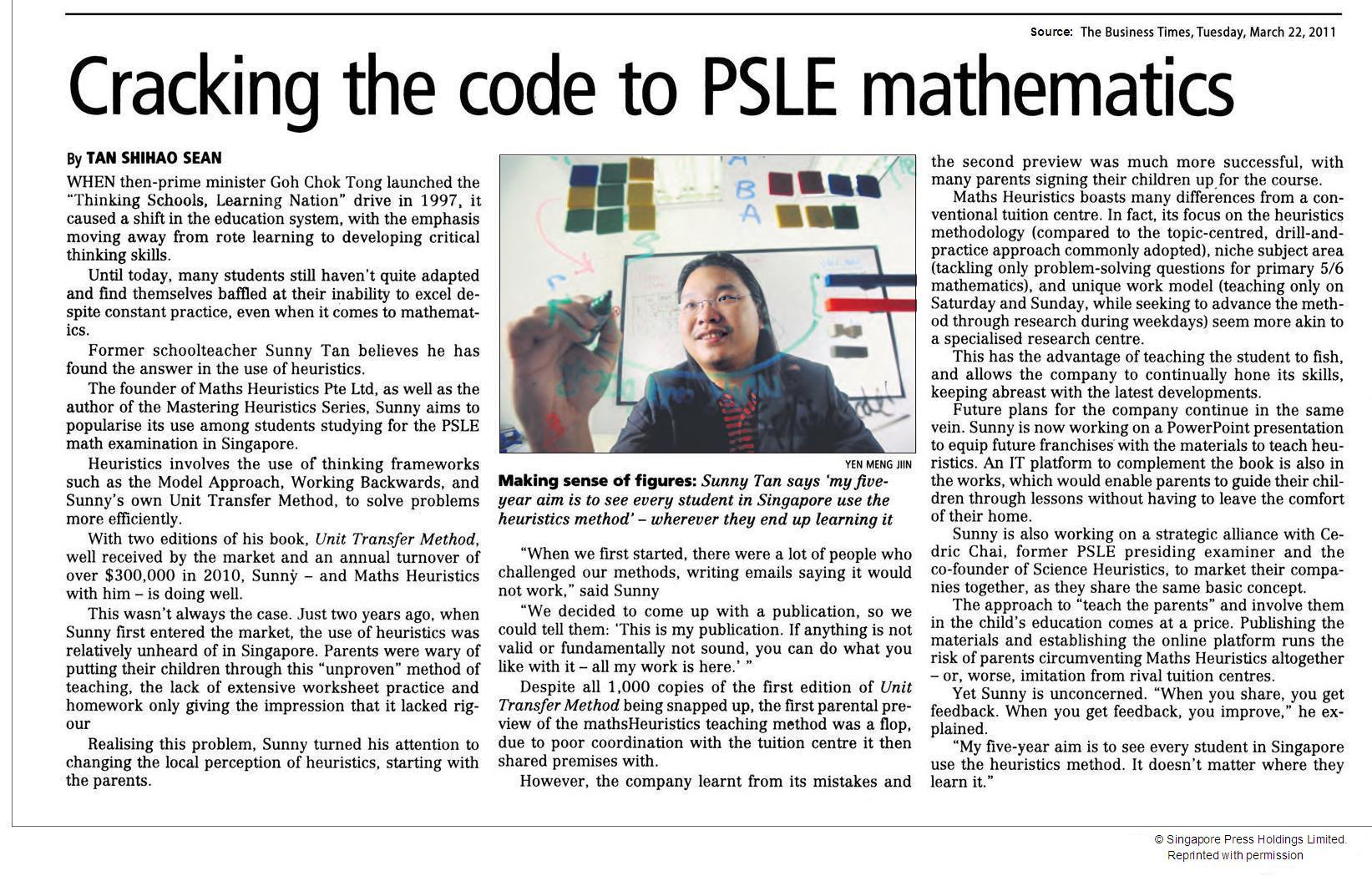
The Mastering Heuristics Series is the brainchild of Sunny Tan, Principle Trainer at Maths Heuristics.

The Mastering Heuristics Series captures Sunny’s simple, systematic yet strong techniques in understanding and applying Mathematical Heuristics. Edited by a strategic marketing communications professional cum parent who understands readers’ psyche and the time crunch parents face, the Mastering Heuristics Series is designed to be highly comprehensive.

Most Mathematics guidebooks provide only answers or, at most, brief workings. Without illustrating each step involved in the workings, readers end up having to figure out for themselves how the author got from one step to another. The Mastering Heuristics Series offers two perspectives:

1. Concepts in action
– to show how easy and efficient Mathematical Heuristics are in solving challenging mathematical questions.

2. Concepts being applied
– to systematically show every step involved in applying each Mathematical Heuristics concept. Easy-to-follow step-by-step instructions make the Mastering Heuristics Series the ultimate practical guide for parents.

The Mastering Heuristics Series consists of four books. The first one, now available, covers six concepts – Before and After, Excess and Shortage, Repeated Identity, Equal, Two Variables, and Ratio and Proportion – under the Unit Transfer Method.

Since its release in the market in January 2009, the book has already garnered coverage by renowned parenting media – ParentsWorld (January 2009) and Wawa Magazine (March 2009) – as well as raving reviews by academia and parents.

Impetus for the School and the Series

While a teacher with Singapore’s Ministry of Education, Sunny observed how the current primary school Mathematics syllabus – different from what today’s parents and teachers were raised on – left many stumped. Mathematical Heuristics has been directly incorporated into the Mathematics syllabus. Teachers are not specifically trained to teach Mathematical Heuristics. Worse still, not neatly self-contained makes Mathematical Heuristics difficult to single out, learn and teach.

Consequently, many parents depend on tuition agencies or private tutors for their children’s Mathematics performance, not realising that most tutors were also raised on the same Mathematics syllabus as themselves, that is sans Mathematical Heuristics.

The more hands-on parents rely on Mathematics syllabus guidebooks to equip themselves to personally guide their children. However, there are no books on the market that specifically teaches Mathematical Heuristics. Where a guidebook comes close to it, its title merely allude to Mathematical strategies (not Mathematical Heuristics), making such books difficult to identify. Once acquired, parents often find themselves second guessing the author’s explanations, and how the author got from one step to another.

With the aim of closing this gap, Sunny emerged with techniques that simplified the application of Mathematical Heuristics. With that as a spring board, Sunny established the mathsHeuristics Programme, and now the Mastering Heuristics Series in 2009. Both Programme and Series are available through Maths Heuristics.

1. mathsHeuristics Programme
– Directly teaches primary students.
– Since its establishment, the Programme has transformed the Mathematics confidence level and performance of numerous students, including a CHIJ P6 student to went from scoring 52% in SA1 to 99% in the Preliminary exam, to A* in the 2008 PSLE – all within just 20 weeks.

2. Mastering Heuristics Series
– Indirectly teaches primary students via parents.
– Backed by mathsHeuristics Programme’s proven track record, Sunny has authored this series of guidebooks based on the Programme’s techniques.

While the Mastering Heuristics Series complements the mathsHeuristics Programme – by keeping parents informed of what their children are learning in the Programme, allowing parents to further support their children in the latter’s Mathematics homework – the Series is also comprehensive enough to be a standalone guide for parents who desire a bigger role in their children’s Mathematics education.

Distribution

Mastering Heuristics Series is available in the US and locally through Maths Heuristics (S) Private Limited. Orders may be placed online (at www.mathsheuristics.com) for home delivery, or in person (at 157A Goldhill Centre, Thomson Road, Singapore 307610) for self-collection.

Media Enquiries

Author / Publisher:
Maths Heuristics (S) Private Limited
Sunny Tan
Principle Trainer
Email: sunny@mathsheuristics.com

Editor / PR Agency:
RE: TEAM
Karen Ralls-Tan
Managing Partner
Mobile: (65) 9787 3081
Email: karen@reteamweb.com

Order Enquiries

Publisher:
Maths Heuristics (S) Private Limited
Christine Tham
Manager
Tel: (65) 6893 5593 (10am – 7pm, Tues to Sun)
Email: admin@mathsheuristics.com

Friday, February 27

ACS - 2008 Prelim Paper Qns

Hi Sunny,


My son tried but could not solve the problem using the UTM. This question is familiar. Can you help and explain to him and at the same time forward me with the solution, please?

Q5: Adeline's monthly salary is $350 more than Bernice. Their monthly spending is the same and each of them spends $800 per month. After some time, Adeline has saved $1950 but Bernice has saved only $900.

(a) How long does each of them take to save the given amount of money?
(b) What is Adeline's monthly salary?

Thanks

Mrs Tan

From the Desk of Sunny Tan........


Catch Us in WaWa Magazine March 2009

The mathsHeuristics will be featured in this coming WaWa magazine March 2009 issue. We have been invited to contribute questions for the WaWa mathematics contest in this issue. There will also be sneak preview on comparasion of using model approach, guess & check and Unit Transfer Method to solve challenging problems. Do encourage your child to participate in this contest and stand a chance to win attractive prizes including a complimentary copy of UTM book. Good luck.

Any Comments?

Dear Mr Sunny Tan,

1/5 of the children at the playground were girls and the rest were boys. When 8 girls left the playground, the fraction of girls decreased to 1/7 of the total number of children at the playground. How many children were at the playground at first? (Ans 120)


For the above Question in the UTM book (Pg 20),

We get the answer is 140 children.

Following is the detail

1/5 are girls and 4/5 are boys = 7/35 are girls and 28/35 are boys

8 girls left , so left 1/7 are girls and 6/7 are boys

1/7 will be equal to 5/35 are girls left.

so 7/35 minus 5/35 = 8 girls left

2 units = 8 girls

1 unit = 4

4 x 35 = 140

Check back the answer as follow

and 28-8 = 20 girls left in the playground.

20/140 = 1/7.

Please check.

Question Posted by Mdm Chong - UTM reader

Thursday, February 26

Questions for UTM readers to attempt?

Posted to all UTM publication readers,

Any UTM readers keen to to attempt the following?
Do post your answers in this blog for discussion.

Clue:
Q1) Chapter 6: Proportion Concept
Q2) Chapter 5: Two Variable Concept
Q3) Chapter 3: Repeated Identity
Q4) Chapter 1.4: Before & After (All changing quantities)


Hi Mr Sunny

Could UTM be used for the following problems?

1) A group of 24 children sold some tickets for a charity show. Each ticket was sold at $5. Each boy sold 5 tickets and each girl sold 3 tickets. The boys collected $40 more than the girls.(a) How many girls were there in the group?(b) How many tickets were sold altogether?

2) There are 85 plates of fried rice for 80 people. Each adult eats 2 plates of fried rice and every three children share 1 plate of fried rice. How many adults and children are there?

3) Four girls, A, B, C and D, each have some stamps. The number of stamps A has is 1/2 of the total number of stamps B, C and D have. The number of B has is 1/3 of the total number of A, C and D have. The number of stamps C has is 1/4 of the total number of stamps A, B and D have. If D has 78 stamps, find the total number of stamps A & B have altogether.

4) At first, Jane had 2/3 as many stamps as Kelly. After Jane bought another 20 stamps and Kelly lost 29 stamps, Jane now has 4/5 as many stamps as Kelly. Find the number of stamps Kelly had at first.

Best Wishes

PSLE Parents

Parents' Concern

Hi Sunny

Please elaborate more on UTM.
Is it a more effective method as compared to other Heuristics?
Is model drawing or Guess and Check a waste of time?
Will the child be confused if he/she is taught a different method from schools?

Concerned parents

Hi Sunny,

Good Afternoon Sir,
As the name of your blog suggests, there is no better way to learn more about UTM than from the guru himself.

As compared to Model Drawing, UTM lacks the visual impact which enables a student to see Maths,so to speak.
In what way is UTM a more effective method than MD?
Could you help to illustrate with some examples?
Is UTM within MOE Maths syllabus?

Interested parents

From the desk of Sunny Tan ... ...

UTM RESEARCH BACKGROUD
The Unit Transfer Method is a fundamentally sound approach with research based on Teacher Work Series publication. Unit Transfer Method uses ratio with tabulation to help child to effectively analyze and solve challenging mathematical problems. This simple, logical yet powerful problem-solving technique is an alternative to the model approach and the algebraic framework approach.


MOE SYLLABUS
Reference to MOE forum replies “Different Approaches taught for Mathematical Techniques” dated 12th Feb 2007, Ms Ho Peng, Director, Curriculum Planning and Development.

“Other than the model drawing approach, pupils are also taught different problem solving methods. They are encouraged to try different approaches and have the flexibility to choose the method that works best for them in solving the problems’

“In the marking of PSLE mathematics, pupils are not restricted to the use of any one particular method. All mathematically correct solutions are acceptable”

In the replies above, the Ministry of Education will accept any mathematically correct method in the PSLE. In fact, the reply mentioned that pupils need a wider repertoire of approaches to work with more challenging problems.

The UTM is very effective in solving problems involving the Before and After Concept, which is one of the heuristics stipulated in the MOE curriculum.


PROBLEM SOLVING HEURISTICS
MOE has recommended 11 problem solving heuristics in primary level. Every heuristics plays a role in problem solving. The common misconception in many parents is that many are trying to search for the “holy Grail” or the most “superior” problem solving methods for their child.

Many parents have always raised these concerns during my seminar, “Is guess and check or model drawing a waste of time?” To answer these concerns, we have to ask ourselves "What is heuristics?"

Heuristics are methods that helps in problem solving. Heuristics does not guarantee a solution.
When approaching the problem, the child first understands the problem, chooses the method and carry out the plan. If it doesn’t work, the method should be discarded and a new method should be choose to solve the problem. However, many pupils or even us will “stubbornly” continue to usie the initial method even it doesn’t work!


UTM VERSUS MODEL APPROACH
As mentioned, many parents are guilty of searching for the “Holy Grail” or the most “Superior” problem solving method. We all know in fact, they never or will never exist.

Different children have different learning style - right and left brain dominant learners.
The left brain learners are strong in logical and analytical thinking while the right brain learner seeks to determine the spatial/visual relationships of all the parts.
The question of which is more superior method is therefore very subjective. Therefore, we cannot answer on behalf of our child. What is important as parents, we should equip the child with different approaches so that they have the flexibility to choose the method that works best for them in solving the problems.

The fundamental concept of the model approach and UTM utilizes ratio. Model drawing is visual or UTM uses tabulation. The combination of Model Approach and Unit Transfer Method utilize the left and the right brain- an integrated "whole" brain approach to maximize the untapped potential of the child.

VISUAL PROCESSING TECHNIQUE
“Do you know Guess and Check can be solved just by using 3 steps?”
“Do you know there are other ways to draw model other than horizontal bar?
By changing the orientation of the model, the answers is staring in front of them!

These are some of the topics that will be covered in the Parents’ Seminar.

Using UTM for this question?

Hi Sunny

Using UTM for this question?

Mr Lim spent $1496 on some comics and dictionaries altogether. The number of comics bought to the number of dictionaries bought was in the ratio of 3 : 2. A dictionary cost $4 more than a comic. The total cost of the comics was 20% more than the total cost of the dictionaries. Find the cost of a dictionary.

February 24, 2009 1:53 PM

From the desk of Sunny Tan ... ...

The concept used for this question is propotion concept. The solution is as follows: