Showing posts with label 1.1 Before n After. Show all posts

Tuesday, April 13

Utilising Advancd UTM Techniques

Mrs Lim said...
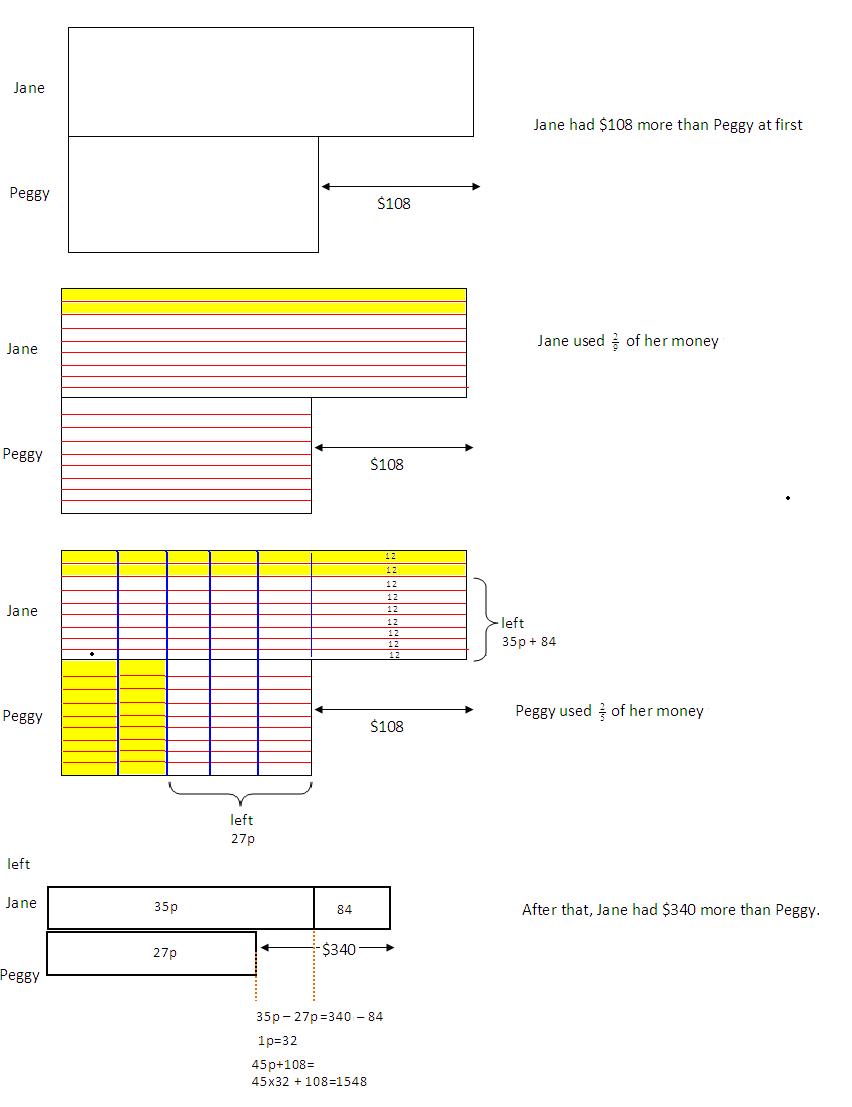
I have bought your Unit Transfer Method Book last month. I was trying to use Chapter 1.4 (All Changing Quanties) to solve the below question from my girl's P6 test paper but somehow just could not solve the question. Question: Jane had $108 more than Peggy at first. Jane used 2/9 of her money while Peggy used 2/5 of her money. After that, Jane had $340 more than Peggy. How many did Jane have at first?
From the Desk of Sunny Tan........


Problems that involve “more than/less than” generally utilize Advanced UTM technique. This problem cannot be solved using “All changing quantities” – questions in “All changing” does not involve “more than/ less than”.
Advance technique involves modification of the basic UTM as follows:


I would advise to teach the child the basic UTM technique and ensure the child is proficient in applying the fundamental UTM framework before to expose them to the advanced UTM. Without the basic training in the UTM framework, the child will faces challenges in visualizing the above conversion and may end up confusing the child.

Below depicts an alternate method to the above problem using the stack model approach :


Saturday, February 20

Maths Problem

Hi Sunny,
Greetings!
My daughter, have attended your PR. 6 sesson.
I have one of her Pr. 6 problem that I know the answer but do not know how to present to her. Based on your method, how do you solve the following question:
Ai Tong School organized a 2-day camp. On the first day, the number of boys was 600 more than the girls. On the second day, the number of boys decreased by 10% but the number of girls increased by 10%. If there were 2540 children on the second day, how many children were there on the first day?
Appreciate your enlightening on the solution.
Thanks.
Mr Lee

From the Desk of Sunny Tan........

(click on image for larger view)

Friday, March 6

Unit Transfer Method Versus Model Drawing

The question is the excerpt from the UTM publication, Chapter 1.1.
The following question is used to illustrate the Model Approach and Unit Transfer Method.

You will realise that the fundamental concept between UTM and MD is the same. While MD uses bar diagram and visual spatialisation, UTM uses tabulation and logical reasoning.

Question

5/6 of the buses were owned by Company C and the rest by Company S. Company S bought another 900 buses and now owns 2/3 of all the buses. How many buses does Company S have now?

Answer:


Try to solve the following using UTM:

Tom had a box of red beads and yellow beads. When he added in 30 red beads, 20% of the beads were yellow beads. He added another 100 yellow beads; as a result, 60% of the beads in the box were yellow. How many red beads were there in the box at first?

Friday, February 27

ACS - 2008 Prelim Paper Qns

Hi Sunny,


My son tried but could not solve the problem using the UTM. This question is familiar. Can you help and explain to him and at the same time forward me with the solution, please?

Q5: Adeline's monthly salary is $350 more than Bernice. Their monthly spending is the same and each of them spends $800 per month. After some time, Adeline has saved $1950 but Bernice has saved only $900.

(a) How long does each of them take to save the given amount of money?
(b) What is Adeline's monthly salary?

Thanks

Mrs Tan

From the Desk of Sunny Tan........


Any Comments?

Dear Mr Sunny Tan,

1/5 of the children at the playground were girls and the rest were boys. When 8 girls left the playground, the fraction of girls decreased to 1/7 of the total number of children at the playground. How many children were at the playground at first? (Ans 120)


For the above Question in the UTM book (Pg 20),

We get the answer is 140 children.

Following is the detail

1/5 are girls and 4/5 are boys = 7/35 are girls and 28/35 are boys

8 girls left , so left 1/7 are girls and 6/7 are boys

1/7 will be equal to 5/35 are girls left.

so 7/35 minus 5/35 = 8 girls left

2 units = 8 girls

1 unit = 4

4 x 35 = 140

Check back the answer as follow

and 28-8 = 20 girls left in the playground.

20/140 = 1/7.

Please check.

Question Posted by Mdm Chong - UTM reader

Thursday, February 26

Questions for UTM readers to attempt?

Posted to all UTM publication readers,

Any UTM readers keen to to attempt the following?
Do post your answers in this blog for discussion.

Clue:
Q1) Chapter 6: Proportion Concept
Q2) Chapter 5: Two Variable Concept
Q3) Chapter 3: Repeated Identity
Q4) Chapter 1.4: Before & After (All changing quantities)


Hi Mr Sunny

Could UTM be used for the following problems?

1) A group of 24 children sold some tickets for a charity show. Each ticket was sold at $5. Each boy sold 5 tickets and each girl sold 3 tickets. The boys collected $40 more than the girls.(a) How many girls were there in the group?(b) How many tickets were sold altogether?

2) There are 85 plates of fried rice for 80 people. Each adult eats 2 plates of fried rice and every three children share 1 plate of fried rice. How many adults and children are there?

3) Four girls, A, B, C and D, each have some stamps. The number of stamps A has is 1/2 of the total number of stamps B, C and D have. The number of B has is 1/3 of the total number of A, C and D have. The number of stamps C has is 1/4 of the total number of stamps A, B and D have. If D has 78 stamps, find the total number of stamps A & B have altogether.

4) At first, Jane had 2/3 as many stamps as Kelly. After Jane bought another 20 stamps and Kelly lost 29 stamps, Jane now has 4/5 as many stamps as Kelly. Find the number of stamps Kelly had at first.

Best Wishes

PSLE Parents

Tuesday, February 24

Can these problems be solved by UTM? - Mrs Sui

Q1) In Hall A, 30% of the 800 people were men. In Hall B 40% of the 400 people were women and children. After some of the people in both hall had switched hall, 25% of the people in Hall A and 75% of those in hall B were men. How many people were there in Hall B after the change?


Q2)During a warehouse book sale, Sally spent 62.5% of her money on 24 books and 18 pens. She also spent 25% of her remaining money on 18 files. Each pen costs 8/9 as much as the price of one book. The file costs $7.80 less than a book. Find the total cost of one book and one pen.


Question posted by Mrs Sui, UTM book reader
Tues, 24th Feb 2009


From the desk of Sunny Tan ... ...

Q1)This concept is covered in UTM book, Chapter 1.2 –Before and After (Total unchanged)
with Chapter 5 – Two variables concept.

i) The total number of men in Hall A and Hall B remain unchanged before and after the transfer.
ii) The total number of women and children in Hall A and Hall B remain unchanged before and after the transfer.
iii) The total number of people in Hall A and Hall B remain unchanged before and after the transfer.


2) The UTM concept to solve this question is covered in Chapter 6 - Proportion Concept.


Friday, February 20

Club A and Club B - Mrs Tan

Hi Sunny,

My son has school worksheet today and he faces difficulty in solving the question below using the Unit Transfer Method.

Club A and Club B had a total of 270 members. Club A had 80% as many members as Club B. During a recruitment exercise, more people joined both Clubs and for every 3 members who joined Club A, one member joined Club B. Given that the ratio of the number of members in Club A to Club B in the end was 2:1, find the number of members in each club in the end.


Question posted by Mrs Tan, Parent
Thurs, 19th Feb 2009


From the desk of Sunny Tan ... ...


Saturday, February 7

UTM book, chapter 1.1, question 7 - Mdm Chong

With reference to the UTM book, chapter 1.1, question 7:

A concert hall has 600 seats. 10% of the seats are VIP seats while the rest are normal seats. How many VIP seats must be added so that the number of VIP seats will increase to 20%?

Please advise what is wrong with the following reasoning:


Question posted by Mdm Chong M.K, UTM Book reader
Fri, 6th Feb 2009


From the desk of Sunny Tan ... ...


Confusion Alert:
The 540 normal seats in the Before and After scenario remains unchanged. However, the percentage of the normal seats changes from 90% in the Before to 80% in the After scenario.
It is important to highlight to the students that percentage is relative to the total sum.
The number of the quantity being unchanged does not imply that the percentage of quantity being unchanged.
Therefore, in the Unit Transfer Method, students are encouraged to convert fraction, decimal, ratio, whole number, and percentage into units as follow:

Saturday, December 13

Glen and Ryan - Mrs Tan

Hi Sunny,

Need your help to solve the following.

Glen and Ryan had $403 altogether. After Glen used 1/4 of his money and Ryan used 1/3 of his money, Glen has twice as much money as Ryan. How much money did Ryan have at first?

Question posted by Mrs Tan, Parent
Fri, 12th Dec 2008


From the desk of Sunny Tan ... ...

click on picture for bigger view

Friday, October 10

3 questions - Mr Shew

Dear Sunny,

Thanks for the extra mile for the consultation session.
Alden has the following questions to ask:

(a) A bill of $72 was paid with $10, $5 and $1 notes. If 13 notes were used for payments, how many notes of each kind were used?

(b) Vanessa and Bobby had some telephone cards. AfterBobby gave 4/9 of his cards to Vanessa, the ratio of the number of Bobby’s cards to the number of Vanessa’s cards became 10 : 17. What was the ratio of the number of Vanessa’s cards to the number of Bobby’s cards at first?

(c) 12 workers took 10 days to make 800 bowls. How many days 3 workers need to make 40 bowls?

Question posted by Mr Shew, Parent
Thurs, 9th Oct 200
8


From the desk of Sunny Tan ... ...

click on picture for bigger view


Tuesday, July 15

Factory Qn - Mr Shew

Dear Sunny,

I came across an interesting problem sum while revising Maths with Alden:

There are 500 male and 200 female employees in factory A. There are 400 male and 600 female employees in factory B. Some employees are transferred from factory A to factory B. After the transfer, the number of male employees is the same as the number of female employees in factory B and the number of male employees is twice the number of female employees in factory A. How many female employees were transferred from factory A to factory B? (Answer: 100)

Could you advise other method besides Model Drawing to solve this question? The question is taken from math456.com P5 Maths CAs and Sas for Top Primary Schools.


Question posted by Mr Shew, Parent
Mon, 14th Jul 2008


From the desk of Sunny Tan ... ...

click on picture for bigger view